
Luhrmann’s Gatsby Is Drowning In Extravagance. But That’s Not The Problem With Luhrmann’s Gatsby.
It's as fun to watch as the book is to read, but something's not quite right.

Since the adaptation was announced back in 2008, the most prevalent anxiety levelled at Baz Luhrmann’s Gatsby was that the director would ruin F. Scott Fitzgerald’s novel with his trademark extravagance, and his painful blindness to nuance. This always seemed a misguided condemnation to me: from beginning to end, the novel itself is packed with extravagance and indulgence. Who better to make a meal of it?
We all knew what the film would look like before the trailers even surfaced; if you’ve been turned off by what you’ve already seen, you’re going to hate this film. Right from its opening, the director takes every image Fitzgerald has brought to life and amplifies it tenfold, until it fits in the hyper-real, imaginary universe in which he’s set the action. The colours border on garish; the camera is sweeping and grandiose in most parts, hyperkinetic in the rest; the 3D, while fun, makes everything feel less real. He’s recast Gatsby in Gatsby’s own fantasy. Which is exactly what everyone expected he’d do.
Early on in the book, for instance, the reader is introduced to Daisy and Jordan, who sit languorously in Tom and Daisy’s living room, in the middle of some serious weather. It’s a ridiculous, wonderful image: “The breeze blew curtains in at one end and out the other like pale flags, twisting them up towards the frosted wedding-cake of the ceiling … their dresses were rippling and fluttering as if they had just been blown back in after a short flight around the house.” It’s all there in Luhrmann’s version — but the wind is now a gale and the curtains seem three or four deep, covering the room like whipped cream.
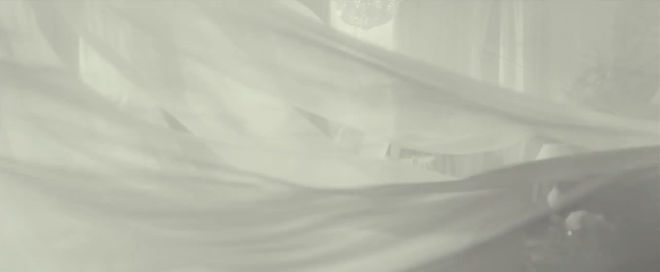
Creamiest. Curtains. Ever.
The exaggeration isn’t just confined to the images; it spreads to the action, too. The hazy, drunken night Nick spends with Tom and his mistress and her friends in New York becomes a drug-fueled orgy; the “endless drill of police and photographers and newspaper men in and out of Gatsby’s front door” becomes a ludicrous gaggle of press and flash-bulb cameras standing over his open coffin; the hit-and-run, which takes up only a line in the novel, becomes a prodigal farce, as Myrtle’s stunned body is flung in slow motion far above the car, before the omniscient Dr. T. J. Eckleburg and his ever-watchful eyes. (The Queensborough billboard is dealt with so ham-handedly there might as well be a flashing arrow pointing at it, screaming: “THIS SIGN REPRESENTS THE JUDGEMENT OF GOD, OKAY?”)
In her piece for New York Magazine, ‘Why I Despise The Great Gatsby’, Kathryn Schultz tears down Fitzgerald’s classic, which she calls “aesthetically overrated, psychologically vacant, and morally complacent”. I disagree with her for the most part — I re-read the book last week, it’s still brilliant — but she’s on the money when she describes it as being like a child’s story, “full of low-hanging symbols”. The green light, the Valley of Ashes, the eyes of Eckleburg – it was all there ready for Luhrmann to play with, and he’s exaggerated it ad nauseum.
But: it’s really fun to watch. The party scenes are phenomenal, overwhelming, meticulously choreographed; Gatsby’s house is magical, framed on Disney’s castle; the reckless driving scenes are exhilarating, the cityscape fantastical — and at the film’s best moment, in a New York hotel room on the hottest day imaginable, the tension and the heat are palpable. Embellished by the soundtrack, Luhrmann’s Gatsby is just as sparkly and euphoric as his fans could wish for — and so just as insufferable as his detractors had hoped.

Where Gatsby the film has failed the book is in the nuances of character. DiCaprio makes a brilliant Gatsby, of course: who else could play such a complex, inscrutable and desperate man-child who longs not for romance but for the past, in a manner that borders on unhinged? But he must have grimaced through his introductory scene, with the big reveal accompanied by a triumphant orchestral blast and excessive, LOL-worthy pyrotechnics.
While Carey Mulligan manages to embody Daisy’s emptiness of character, onto which all kinds of fantasies get projected (no one’s voice can “sound like money”), she’s too perennially close to tears to be emotionally void, and too sweet-seeming to be so cynical. More importantly, she has almost none of the playfulness that makes her character so likeable in the book. (This could be a fault of the scripting. The rapport between her and Nick is laugh-out-loud funny on the page, but the film — whose humour is mostly visual — makes nothing of it.)
Joel Edgerton makes a fine Tom — brutish, overpowering, strong and boring — but Tobey Maguire’s Nick Carraway is milquetoast, ineffectual, and totally bland. It’s a tough role to play (his voice narrates the novel, so by the role’s very nature he has to spend most of the film in the background, watching people like a creep), but there’s hardly any chemistry between he and Daisy, and Jordan – who, played by the infinitely watchable Elizabeth Debicki, becomes by far the most interesting and complicated character in the film — might as well be his sister.
It’s not helped by the film’s facile framing device. Future-Nick-Carraway narrates the story from a sanatorium where he’s recovering from “morbid alcoholism”, before his shrink tells him to write it all down. Fitzgerald’s words float out from the screen like a year 12 video art project — it’s a juvenile trick, rivalled only by the newspaper headline montage Luhrmann lazily uses to tell parts of the story. But the problem goes much deeper than simple cringeworthiness: as Dana Stevens for Slate points out, the Nick-As-Author invention turns a book about morality, character and class in post-war America into “a self-referential bildungsroman about a young man’s journey to healing through authorship. When Nick finally pens in “The Great” over his manuscript’s original title Gatsby,” she continues, “we don’t so much feel pride in his accomplishment as annoyance at his smugness — he’s supposed to be telling us this story out of necessity, not ambition.”
In the novel, each character represents an idea — old money, new money, The Great American Dream — making none particularly relateable, and making the book necessarily devoid of emotion: it’s about so much more than romance. Try as Luhrmann might to inject more feels – by showing Daisy stalling by the phone, deciding whether to call Gatsby after she abandons him; by making his phone finally ring moments before the gun shot cries out (“Daisy,” he whispers, stupidly, as he dies) – the film thankfully retains the emptiness the story needs to be so powerful. But that’s testament to Fitzgerald’s writing, not Luhrmann’s directing.
–
The Great Gatsby comes out today in Australian cinemas.