

Does The ICAC Even Work, Or Is It All Bark And No Bite?
We spent a day at ICAC, and it was very depressing.

The offices of the Independent Commission Against Corruption are not particularly impressive: a series of low-ceilinged, beige-on-beige rooms on the seventh floor of a skyscraper on Castlereagh Street, that could just as easily host a low-rent admin operation, or an accounting firm. It’s Friday morning, and the hearing gallery is slowly filling with barristers, clerks, witnesses and rubbernecking members of the public keen for another round of the running battle that is Operation Spicer, ICAC’s investigation into corrupt conduct around the activities of Australian Water Holdings (AWH).
Operation Spicer is trying to determine whether AWH, a private company contracted by the state-owned Sydney Water to build infrastructure, funnelled public funds to the NSW Liberal Party before the 2011 state election. It is slowly working its way through a laundry list of businesspeople, lobbyists, politicians and advisors to piece the puzzle together. It is Friday May 9 when I visit the Commission, and the big fish up for dissection is Nicholas di Girolamo, the former executive chairman of AWH who sits at the centre of ICAC’s claims. It was di Girolamo’s infamous bottle of 1959 Penfolds Grange that brought down Premier Barry O’Farrell last month, but today will be far less sexy; the memorable day O’Farrell resigned was a break in character for ICAC, which is not given to large sensationalist revelations.
Today will be more like trying to do an infuriatingly complex Sudoku puzzle while someone whispers random numbers in your ear. As the prosecuting counsel tries to slowly draw out admissions and scraps of knowledge, the lawyers on the other side seek to object, adjourn and otherwise defer their client’s day of judgment as far into the future as possible. Hours are spent untangling knotty, legalistic questions of who did and said what to whom, and when and “in what manner” they did or didn’t do or say it. Some of the people in the witness box frequently “don’t recall” seemingly major details, and spin convoluted, rambling answers out of simple questions in a way that distracts if you’re not careful.
It would be hard enough to keep track of all the people, corporations, emails, phone calls, transactions and communiques without a hardworking and highly-paid team of lawyers trying to make sure you didn’t. For an organisation dedicated to uncovering the truth, those uninitiated in ICAC’s byzantine workings won’t find much enlightenment here.
The Corruption Watchdog: All Bark, No Bite?
ICAC was originally designed as a political beast. In 1989, Liberal Premier Nick Greiner was swept into power in a landslide after a series of corruption scandals rocked the Wran and Unsworth Labor governments. He established ICAC shortly after. Its first investigation was directed against Greiner’s predecessors, and looked to be the instrument that would keep NSW Labor out of power for twenty years. But if ICAC was meant to be a “permanent royal commission into Labor,” it backfired when Greiner himself was forced to resign in 1992, after ICAC found his government had offered a plum appointment to an independent MP in exchange for his resignation from Parliament.
More than twenty years later, ICAC can still break governments, Premiers and parties. Barry O’Farrell came into power promising to clean up state politics after ICAC exposed the vast influence of the Obeid family and heard that former Labor Minister Ian Macdonald took bribes from businessman Ron Medich, including sexual favours from a prostitute. Just three years later O’Farrell himself is gone, and the NSW Liberal Party is in dire straits thanks to ICAC’s tenacity.
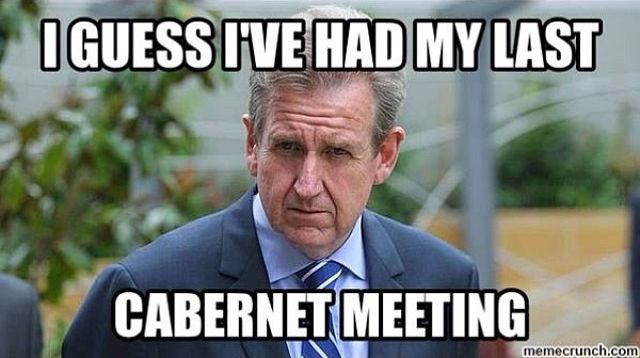
Besides O’Farrell, Operation Spicer and its predecessor Operation Credo have forced the resignations of Police Minister Mike Gallacher, Minister for Resources and Energy Chris Hartcher and a number of state Liberal MPs who may have, deliberately or otherwise, used money from illegal donations to campaign in the run-up to the 2011 election (Update: As of August 27, eleven state and federal Coalition MPs have stood aside from their positions after being named in ICAC investigations.)
ICAC has claimed so many scalps thanks, at least in part, to its extraordinary powers. Unlike anti-corruption bodies in other states — like Queensland’s Crime and Misconduct Commission, which has just been watered down — ICAC has a mandate rivalled only by a Royal Commission. It can compel people to give evidence, seize emails and tap phones, and hear evidence that would be inadmissible in court. The watchdog has proven so politically potent that there are growing calls for a federal counterpart to be established in Canberra, and the Commission has been accused by federal politicians of unfairly ruining reputations and careers.
All this political fallout makes for good headlines, but whether ICAC will succeed at its task — uncovering and rectifying corruption — is another matter altogether. Crucially, ICAC cannot charge people with criminal offences; it can only recommend that charges be laid by the Department of Public Prosecutions, a process that takes time and requires evidence to be painstakingly gathered all over again. ICAC recommended Eddie Obeid face charges in July last year and he’s yet to appear in court; in the meantime he’s still out and about.
ICAC also recommended charges against five businessmen: Travers Duncan, John McGuigan, John Atkinson, John Kinghorn and Richard Poole. While they were named and shamed in the media, none are likely to see the inside of a jail cell; all five are immensely wealthy, and the kind of lawyers they can afford are very good at keeping their clients out of prison. Since then some of them have been spotted floating around Parliament House, meeting with MPs.
If ne’er-do-wells everywhere really should fear ICAC, no one seems to have told them.
“I Don’t Recall”
The Counsel assisting the Commission — the lawyer tasked by ICAC with heading up Operation Spicer — is Geoffrey Watson SC, a big balding man with rounded glasses. For the last few weeks he’s had the run of the investigation, questioning witnesses and presenting damning evidence that ties many of them in knots. Today he‘s in total control of the room, leaning confidently on his podium and speaking over witnesses if he doesn’t like their answers. He accuses millionaires and members of Parliament of lying and defrauding the public like he’s discussing the weather. He’s reprimanded once or twice by the hearing’s Commissioner, Megan Latham, for raising his voice at witnesses.
Before di Girolamo takes the stand, Watson has a crack at a few smaller fish. Marie Ficarra, a Liberal Upper House MP that the Commission claims facilitated an illegal $5,000 donation from a property developer to sham company EightByFive, and Peter McConnell, Barry O’Farrell’s former chief of staff. Neither of them do very well. At one point, Ficarra claims she was distracted from events because her schnauzer Liesl was sick; she repeatedly denies assertions from that she has made up testimony on the run. McConnell withers like old lettuce as Watson presents a series of emails showing that he helped AWH draft a proposal for submission to then-Premier Kristina Keneally’s Chief of Staff, Walt Seccord. Watson accuses McConnell of operating on AWH’s timetable instead of the public’s, and McConnell has little to offer but mumbles and impotent “no”s in reply.
The room breaks for lunch and Watson ducks into the “media gallery” — it’s really a glorified break-room — to powwow with the twenty or so journalists who are following proceedings. Balancing their tablets and copies of today’s Telegraph on dinky little IKEA tables and bright green chairs, the reporters have been embedded in this room for weeks in case a big story breaks. The Fairfax scribes, fresh from last week’s 24-hour strike, occupy the best spot directly underneath the twin flat-screen monitors that broadcast proceedings from the hearing gallery around the corner.
There’s an atmosphere of camaraderie, even conspiracy; they swap memes of their own creation and giggle at in-jokes that are incomprehensible to outside eyes. Watson is droll and composed, and the reporters appreciate his deadpan sense of humour and the easily quotable lines he regularly spits out on the stand. For some reason his coffee mug of choice is a piece of merch from Sydney dance outfit Seekae. “I nicked it from my son; they’re quite good, apparently. Want to see something disgusting?” He tips his coffee into the sink and shows the room the inside of the mug; it’s mud-brown, the byproduct of innumerable late nights. “I really should wash this.”
At twenty-five past two di Girolamo takes the stand, and Watson’s assistant counsel Greg O’Mahoney takes over. The public gallery is packed. Di Girolamo is another big man, with dark shadows under his eyes and a voice like a pack-a-day smoker. O’Mahoney, by contrast, is a small, dapper character in a well-fitted charcoal suit. He’s no less tenacious than Watson, aggressively questioning di Girolamo over how and why AWH, a company that operated at a loss of hundreds of thousands of dollars over two years, managed to donate tens of thousands to the NSW Liberal Party over the same period. He’s met with a blank wall; besides meaningless admissions and explanations so vague they don’t deserve the name, the only words out of di Girolamo’s mouth are “I don’t recall”.
O’Mahoney keeps digging, unpicking a smear campaign orchestrated against Kerry Schott, the former head of Sydney Water who urged the government to cut ties with AWH; trying to establish links between di Girolamo, Chris Hartcher and Mike Gallacher. Di Girolamo quibbles over definitions, “doesn’t understand the question” several times, and otherwise keeps mum. Through all this the media gallery hums, working up the next headline; the room is silent but for the furious tapping of keys and muttered phone conversations to editors. There’s enough juicy stuff from earlier testimony to keep the word “ICAC” on front pages and to give the government headaches for the foreseeable future, but any prospect of something truly significant coming out of today has long since fizzled out. Worse, time is against O’Mahoney; ICAC is due to shut at 4pm and won’t reopen until Monday. The afternoon slips away. Their articles written and filed, the reporters flag, start looking at their phones. Time is called, and everyone starts packing up for the weekend. Despite their best efforts, O’Mahoney and Watson haven’t laid a glove on di Girolamo.
ICAC seems to be genuine hell for any politician stupid or venal enough to take bribes, give out deals for the boys or otherwise act dodgy. But it takes two for corruption to flourish — one to take a bribe, and one to give it — and Watson and co. are no doubt learning that putting a rich crook behind bars is far harder than getting a Premier fired. ICAC’s meant as a cure for corruption, but it might only be treating the symptoms.
–
Alex McKinnon is a Sydney-based writer and journalist, and former editor of The Star Observer.