

How Do We Respond To Sex On Screen? Observations After Watching ‘Blue Is The Warmest Colour’
The internet has changed the way we watch sex scenes, taking control out of the director's hands and into our own.

Last week I tramped through the snow to a cinema in Brooklyn, and watched two women have sex. I was watching Blue is the Warmest Colour, the critically acclaimed winner of the 2013 Palme d’Or, which was released in the U.S. at the end of October, but won’t screen in Australia until February 13.
If you’ve had access to the Internet in the last six months and used it to browse any kind of opinion-driven pop culture site, you’ll know that the film has been highly controversial. And that it features some of the most torrid sex scenes in popular memory — one of which lasts for seven minutes.
Directed by Abdellatif Kechiche, Blue is the Warmest Colour is about the coming-of-age of Adèle (Adèle Exarchopoulos). It begins when she’s 15 years old, and documents the relationship she forms with a blue-haired artist named Emma (Léa Seydoux), tracing the love story over a seven-year period. In many ways the character of Adèle and the story the film tells are archetypal. Adèle is beautiful, this vibrating, holy creature of appetite who is brought into consciousness by an older, wiser lover.
The controversy has less to do with the story, and more to do with Kechiche’s portrayal of lesbianism and sex. In part this was sparked by both Exarchopoulos and Seydoux when, in a September interview with The Daily Beast, they said that the experience of making the film had been unbearable, with Exarchopolous describing a one hour continuous take in which Kechiche has Seydoux hit her over and over again as “horrible”, and both actors saying they would never work with Kechiche again.
Their comments were held up by many critics of the film as proof of everything problematic about it. Both Julie Maroh, who wrote the graphic novel on which the film is loosely based, and Manohla Dargis for The New York Times, likened Kechiche’s filming to mainstream pornography. Michelle Juergen, writing for Salon, argued that the film, riddled with Kechiche’s ‘male gaze’, “[gets] lesbian sex wrong.” Ashton Cooper, writing for Jezebel, also had reservations about the depiction of lesbian relationships, although she pointed out that relentless criticism of the film wasn’t productive.
The theme that runs through all the kerfuffle around Blue is the Warmest Colour is the intense and conflicted responses different people have to sex on screen. While for the most part the criticism of the film is intelligent and well-informed, it also tends to stray well into the arena of feelpinion. But that’s the difficulty with talking about sex in film: your experience is going to be erotic as well as intellectual. And that experience is going to inform your emotional relationship to what you’re watching, and your judgment of it.
The way we respond to sex scenes is what I find most interesting about them, more interesting than talking about the sex scenes themselves. The biggest question, for me, is about how we process the responses to sexy stuff. Because sex is supposed to be not a big deal anymore, right?
Sex Doesn’t Sell Anymore
Sex has been a vital part of the history of film. In the early days of Hollywood cinema, nudity, sex or the illusion of either held such an advantage that the director Cecil B. DeMille made bathing scenes obligatory. It was only after 1933 and the introduction of the Hays Code that obscenity was dialled back, and even married couples were expected to be shown sleeping in twin beds. The raciest a filmmaker could get was some cigarette-based innuendo and brief but ardent closed-mouth kissing.
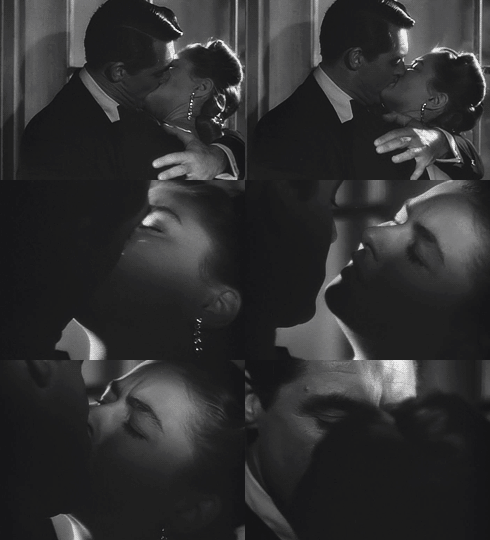
The sexual revolution of the ‘60s ushered in the first topless woman in a Hollywood film (Jayne Mansfield), the first shot of a woman’s pubic hair (Blow Up), and a decade or so of explicit films that probably couldn’t be made today, including Last Tango in Paris, Pink Flamingos, A Clockwork Orange and Midnight Cowboy. 1972’s Deep Throat, a 60-minute porno about a lady who misplaced her clitoris in her throat, became a mainstream phenomenon, and is often credited with establishing the blowjob as part of the collective consciousness. I mention that because it demonstrates how important cinema was to our changing attitudes and knowledge of sexuality during the 20th century. Taboos were rarely broken until they were broken on screen. This continues to be the case.
The difference is that nowadays, sex is a liability when it comes to the commercial success of movies. Sex scenes are a hassle: they need rehearsing, the development of chemistry between actors, the clearing of no-nudity clauses, and battles with both domestic and international classification boards about ratings. Compare two recent films about sex addiction: Shame (2011) and Silver Linings Playbook (2012). The sex-riddled indie Shame grossed $4 million at the American box office, whereas Silver Linings Playbook, which included no sexy scenes, grossed $132 million. Obviously, the films’ respective success isn’t dependent on their quota of racy material alone – their hugely disparate budgets, distribution and teams of cheerful marketing executives play a not insignificant role. But what is striking is that you would once have expected the box office hit to have quite a lot of sex, particularly when the narrative depends on a sex addict. ‘Sex sells’, and so on.
Last year Vincent Bruzzese, president of the market research firm Ipsos’ motion picture group, explained that, “Sex scenes used to be written, no matter the plot, to spice up a trailer. But all that does today is get a film an adult-only rating and lose a younger audience.” In fact, sex sells so poorly that “[t]oday such scenes are written out by producers even before they are shot.” It’s more financially secure to produce family-friendly movies, or to pack a film full of CGI action and gun violence. An article by Jay Epstein for Slate quoted one Hollywood studio executive as saying, “We may have to leave sex to the independents.”
Which is exactly what’s happening. You’re more likely to find sex on screen in independent cinema, regardless of the film’s national provenance. Of the Top Ten Grossing NC-17 films, five were released in the last decade: Bad Education (2004), The Dreamers (2004), Lust, Caution (2007) Shame (2011), and Blue is the Warmest Colour (2013). Of the five only one was a solely English language film, and all were independently produced.
You’re also more likely to find it on TV. According to Wired, sex is being used to make television “smarter.” It’s a way for writer’s to keep your attention while they explain complicated theories of power, politics and dragon lore. Shows produced by companies like AMC (Mad Men), Showtime (Masters of Sex) and HBO (Game of Thrones, Girls) have upped the number of sex scenes exponentially. They know who their target audience is, and thus they’re able to produce both intelligent and sexually explicit content. Wired picks out Game of Thrones for special attention, which uses sex as an important plot-driver, and a means of thematic and relational exposition.
The Inevitable Part Where We Bring Up Lena Dunham
This liberation of sex from mainstream Hollywood film to independent cinema and television has arguably made sex on screen much more interesting, and it’s being used by some filmmakers as an important storytelling device. The taboos that once could have been tackled in Hollywood cinema are now being tackled in a show like Girls. Lena Dunham writes with the ethos there there’s something important and significant about sexual experience in and of itself. The sex shown on Girls breaks taboos, and, as a consequence, upsets a great many people.
An excellent example of this was the reaction to the Season 2 episode ‘One Man’s Trash’, in which Hannah has a three-day affair with a 42-year-old man played by Patrick Wilson. The sex scenes in the episode, analysed brilliantly by Emily Nussbaum, were so intimate that at times they felt invasive. But they also explore something central to the characters and the story. They demonstrate what Girls has always gone some way towards trying to prove: that intimacy is a legitimate subject for art. And because of that, the sex scenes on Girls, while hated by many and derided as ‘ugly’, are unequivocally meaningful.
And that’s important, because most sex scenes on screen are redundant. They’re filmed from the same angles, they’re lit in the same way, the characters do the same things. They’re generally pretty brief. There’s some writhing, some sighing, some moaning. They’re boring. Because they’re signifiers. The director’s either just fancied filming a bit of gratuitous sex, or it’s a lazy way of demonstrating to the audience that the characters are people who have sex with one another. They rarely show anything significant or meaningful about the sexual relationship, or shed much light on the story as a whole.
On the other hand, the sex scenes in Blue is the Warmest Colour are meaningful. They would be remarkable for their duration alone, but they are also exceptional for the sheer physicality of the sex, the way they demonstrate the ardour each woman has for the other. There is an emotional weight to the scenes that makes them central to the story. Richard Brody, in a blog for The New Yorker, argued that “Kechiche brought trouble on himself — not by the decision to film sex scenes between two women but by the audacity of his artistry in doing so. The problem with Kechiche’s scenes is that they’re too good — too unusual, too challenging, too original — to be assimilated to the familiar moviegoing experience.”
The Blurry Line Between Art And Pornography
Blue is the Warmest Colour will not be the only film released this year that focuses public discussion on sex. Lars von Trier, a man who has an entire section of his Wikipedia page devoted to ‘Explicit Images,’ is set to release Nymphomaniac in March.
Nymphomaniac is another film about a sex addict, starring von Trier’s muse Charlotte Gainsbourg; it includes multiple sex scenes, many of which verge into the sadomasochistic. In an interview with The Guardian, one of the film’s lead actors Stellan Skarsgaard argued that the film shouldn’t be considered pornographic. “Pornography has just one purpose, which is to arouse you. To make you wank, basically. But if you look at this film, it’s actually a really bad porn movie, even if you fast forward. And after a while you find you don’t even react to the explicit scenes. They become as natural as seeing someone eating a bowl of cereal.” This is a valid argument, the first part at least. But Skaarsgard’s final point about the sex scenes acquiring the same boner-inducing potential as your haggard housemate eating Cornflakes of a morning is a little weak.
The distinction between art and pornography is more problematic than it has ever been before. In a lot of pre-Internet age art criticism, the distinction between art and pornography was dependent on function: a work of art may be pornographic, but pornography can’t be art, because pornography has a function – wanking – and art is not functional. But that distinction has been obliterated by the Internet, because no matter the intention of the filmmaker or artist, people can still use their work functionally, as pornography. A quick Google search reveals Nerve’s Hollywood Sex Scene database. Abstracted, people will use scenes from Nymphomaniac and Blue is the Warmest Colour for a function. It makes it much harder to be taken seriously when trying to talk about sex scenes in cinema.
The Discerning Viewer’s Dilemma In An Age of Infinite Abstraction
The Internet allows us to abstract information and simplify it in the same way that it allows us to condense music into mp3s and images into GIFS. It’s efficient, but it’s bland. Loss-y. It allows us to absorb information context-free, and then it encourages us to form strident opinions in a vacuum of meaning. As a consequence, art is entirely at the mercy of the perceptions of the person watching.
And those perceptions become so much more heightened when it comes to sex. The Finnish academic Susanna Paasonen has an excellent term for the way sex on screen affects us: “carnal resonance”. Pornography is designed to affect you; the bodies moving on the screen are meant to move you. Cinematic sex scenes, while not created to fulfill that function, work with the knowledge that it’s a very real possibility that you’ll get caught in that affective loop. That you’ll be, ahem, ‘moved’. That gut reaction that you have can be positive, or it can shift over to disgust and shame when your eyes are assaulted by something like ‘Two Girls, One Cup‘. But whatever it is that you feel, you’re going to feel it before you can consciously process and intellectualise anything. It’s going to inform your response to whatever you see, and that’s what makes talking about sex scenes so difficult. So much of the time people are talking about themselves.
Walter Benjamin talks about the storyteller as a kind of mysterious stranger who brings news from the dark beyond the edge of the village firelight. If a storyteller is going to survive in his trade, he has to have a pretty good instinct for his audience’s limits. But if a storyteller is going to be any good, he stretches those limits and adds to the frame of reference. That means the storyteller has to risk speaking unspeakable things – patricide, adultery, murder, violence and sex. It’s risky, but it stretches our frame of reference.
It’s worth noting that in the same essay, Benjamin argued – and this was eighty years ago, mind you – that the rise and proliferation of information was incompatible with the storyteller, and contributed to his diminished effectiveness and power. In some sense, this explains how Blue is the Warmest Colour has gotten away from Kechiche: he has little control over how meaning is experienced or understood by the audience. And society has reacted to the film the way it has because many of us have limits that we don’t want challenged. In a way, it’s not surprising. If anything, what the controversy proves is that, despite our generation’s wantonness, sex is still a big deal.
–
Blue Is The Warmest Colour will be in Australian cinemas from February 13.
–
Madeleine Watts has contributed to The Lifted Brow, Griffith REVIEW, Concrete Playground, FasterLouder and Broadsheet. She lives in Sydney.