

The Five Best Martin Scorsese Films To Prepare You For This Month’s Scorsese Love-Fest
Hope you like Robert De Niro!

Martin Scorsese has long been acknowledged as one of the most influential auteurs of the late 20th and early 21st centuries, but celebration of him is reaching new heights in Australia this month. A major exhibition of his work, curated by the Deutsch Kinemathek, has just opened at the Australian Centre for the Moving Image in Melbourne. And, to coincide with this, David Stratton has put together a retrospective of Scorsese’s films, screening at both ACMI and the upcoming Sydney Film Festival.
As the director’s work has such a distinctive reputation — dudes, crimes, dudes doing crimes! — there are a few additions in the 10-part series which may appear as oddities. (Most notably, the musical New York, New York and the high society period romance The Age of Innocence). But, when looking at Scorsese’s body of work as a whole, it’s clear his themes of human yearnings and pitfalls are as much at home among 19th century counts and countesses as they are in a 20th century mafia family.
For Goodfellas’ Henry Hill (Ray Liotta) and Casino’s Sam Rothstein (Robert De Niro), survival is an ongoing negotiation of personal interest, destructive impulse and often-conflicting notions of honour and duty. In The Age of Innocence, the quiet tragedy stems from the honourable Newland Archer’s (Daniel Day Lewis) denial of his own feelings in favour of meeting the expectations imposed by a repressive society. This sensitivity to the complexity of the contradictory, flawed, and ultimately unknowable human experience goes a long way towards explaining the filmmaker’s enduring influence.
In honour of the current celebration of Scorsese’s contribution to cinema, here are the five films that bring his saints and sinners, hustlers and dreamers most powerfully to life:
–
5. The King of Comedy (1982)
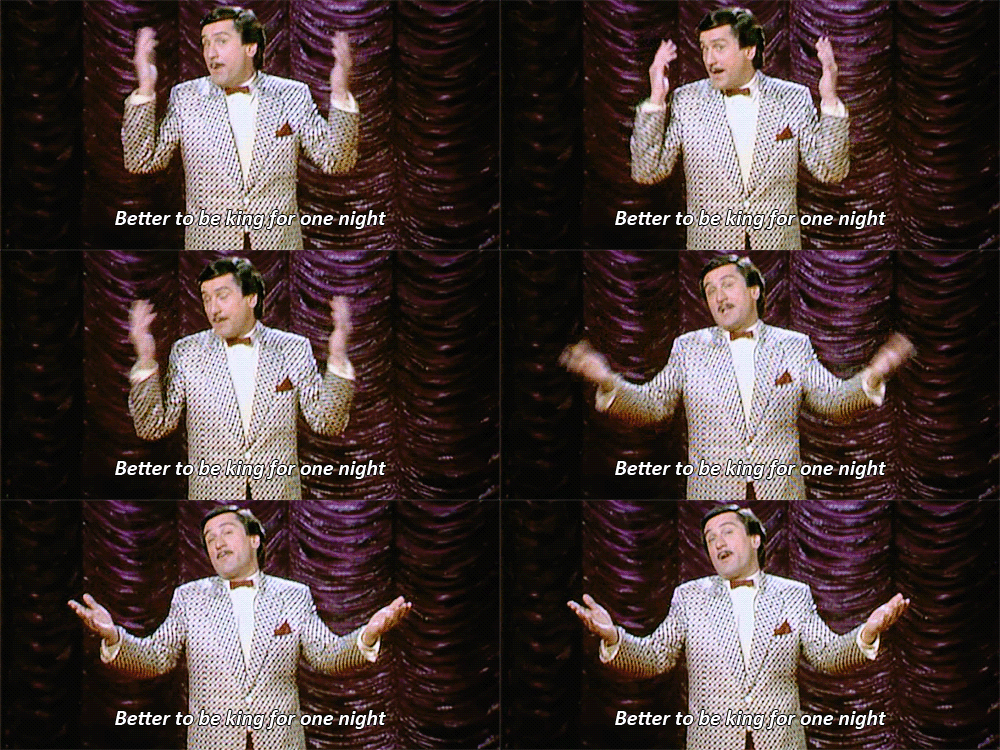
Scorsese’s most serious films tend to reveal comic absurdities about the human condition, but his 1982 comedy is seriously dark. Wannabe comedian Rupert Pupkin’s (Robert De Niro) deluded belief that he enjoys a friendship with talk show host Jerry Langford (Jerry Lewis) provides the basis for the film’s satire of celebrity culture.
It’s excruciatingly effective, but Pupkin’s issues go beyond culture to be almost existential in nature. His unshakeable belief that he’s been wronged by Langford prompts him to embark on increasingly bizarre acts, all justified under the pretext of being in the right. Insanity here is not without its own closed-minded logic, and it’s the deadpan delivery that makes The King of Comedy one of Scorsese’s most memorable films.
–
4. Taxi Driver (1976)
Rupert Pupkin is not so different from Travis Bickle (also Robert De Niro). For both men, their tragedy revolves around an inability to perceive that people don’t always mean what they say. The subsequent perception of having been lied to produces a profound sense of betrayal.
In Bickle’s case, this comes in the form of political staffer Betsy (Cybill Shepherd), who is initially intrigued by the taxi driver, but quickly comes to the conclusion that he’s just plain crazy. His eventual confrontation with her, in which he proclaims a bitter victory in his knowledge that she’s been avoiding him, is one of Scorsese’s clearest depictions of a furious, inarticulate, self-defeating desire to be recognised.
This is made all the more powerful by the fact Bickle is a Vietnam veteran struggling to find his place back in society. Despite the fact that the action takes place exclusively in New York City, Taxi Driver is one of the strongest statements that the American cinema produced on the Vietnam War.
–
3. Mean Streets (1973)
Scorsese embarked on Mean Streets after working on the B-picture Boxcar Bertha (1972) as American auteur John Cassavetes advised him to devote himself to projects that he actually cared about. With Mean Streets, Scorsese began to experiment with some of the visual techniques that would become a hallmark of his filmmaking style, including an expressionistic use of colour and elegant if complicated tracking shots.
As a result, the director’s third feature has a dreamlike quality. It evokes the spiritual struggle of a junior member of the New York mafia as he attempts to integrate his professional life into the moral rubric imposed by his Catholic faith. Desperate to atone for his actions, if misguided in his attempts, Charlie (Harvey Keitel) is one of Scorsese’s most sympathetic protagonists, and Mean Streets is one of his most heartbreaking films.
–
2. Goodfellas (1990)
Like 2013’s The Wolf of Wall Street, Goodfellas was met on its release with accusations of having glorified the criminal milieu that it takes as its setting. Characterised by sumptuous design and photography, and heavy reliance on voiceover narration, there’s an almost fetishistic quality to each of these films. Yet, as is the case with Jordan Belfort, there is also something comically absurd in Henry Hill’s transparent and unwavering (if regularly self-defeating) pursuit of his own self-interest.
As a child, Henry dreamed of power and becoming a gangster. But the thrill that he and his wife, Karen (Lorraine Bracco), exercise in accumulating excessive amounts of useless and gaudy stuff goes a long way towards hinting at the limitations of those childhood aspirations. In place of moralising, Goodfellas identifies what is petty and banal in criminal life, mining it for comic effect.
It’s one of Scorsese’s most polished if tonally ambiguous films. But what makes it one of his best is its successful recreation of a world that is both horrifying and driven by emotions that are at times uncomfortably familiar.
–
1. Raging Bull (1980)
De Niro had to persuade Scorsese to direct boxing picture Raging Bull, and even after the feature was released, the filmmaker persisted in describing the sport as “boring”. Despite this, there is a poetic quality to his treatment of the ritual and of the paraphernalia surrounding the sport, and a highly charged energy to middleweight champion Jake LaMotta’s bouts in the ring.
An adaptation of LaMotta’s memoir of the same name, Raging Bull challenges the notion that our identity at work is separate from our personal life, and suggests that we do ourselves harm in refusing to acknowledge our lack of control over our needs and desires.
The black and white picture is Scorsese’s most striking portrayal of human fallibility, describing the life of a man with undeniable talent in the ring, but an inability to function outside of it.
–
If you’re in Melbourne, check out SCORSESE, Essential Scorsese and a Scorsese-filled program at Friday Night Cinema between now and September 16. Sydneysiders: you’ll need to catch Essential Scorsese at the Sydney Film Festival from June 11-19.
–
Alice McCredie-Dando is a freelance writer based in Sydney. She writes on cinema from her blog american night.