

The Australian-Made ‘Assault Android Cactus’ Kicks Some Serious Butt On Switch

Rebranded as Assault Android Cactus+ for its Switch release, the Australian-made twin-stick shooter is still brilliantly challenging, yet more accessible than ever thanks to new features.
Cactus+’ main campaign mode revolves around an android police officer named Cactus who attempts to restore order to a civilian space vessel overtaken by rogue, violent AI foes. However, the plot isn’t the focus here, instead acting as a setting for intense robot shoot-em-up action. While Cactus is the main character, you’ll be able to play as other allied androids, unlocking more as you progress through levels, each with their own unique weapon loadout suited to different play styles.

Cactus’ primary weapon is a straight-shooting machine gun, with a flamethrower secondary ideal for scorching targets up close and dealing large damage in short bursts. In contrast, Holly’s primary shoots homing bullets that automatically target enemies – ideal for newer players.
In line with other games in the twin-stick genre, Assault Android Cactus+ uses the left stick to move your character through flashy firefights, while the right-stick acts independently to control your aim in a 360-degree axis. To shoot, simply hold down “ZR”, or equip your secondary weapon by tapping “LR” first. Secondary weapons are limited-use, whereby exhausting them requires a brief cooldown period before firing away again, represented by a circle surrounding your character, but you can shoot primary guns all you like without fear of overheating or having to reload.
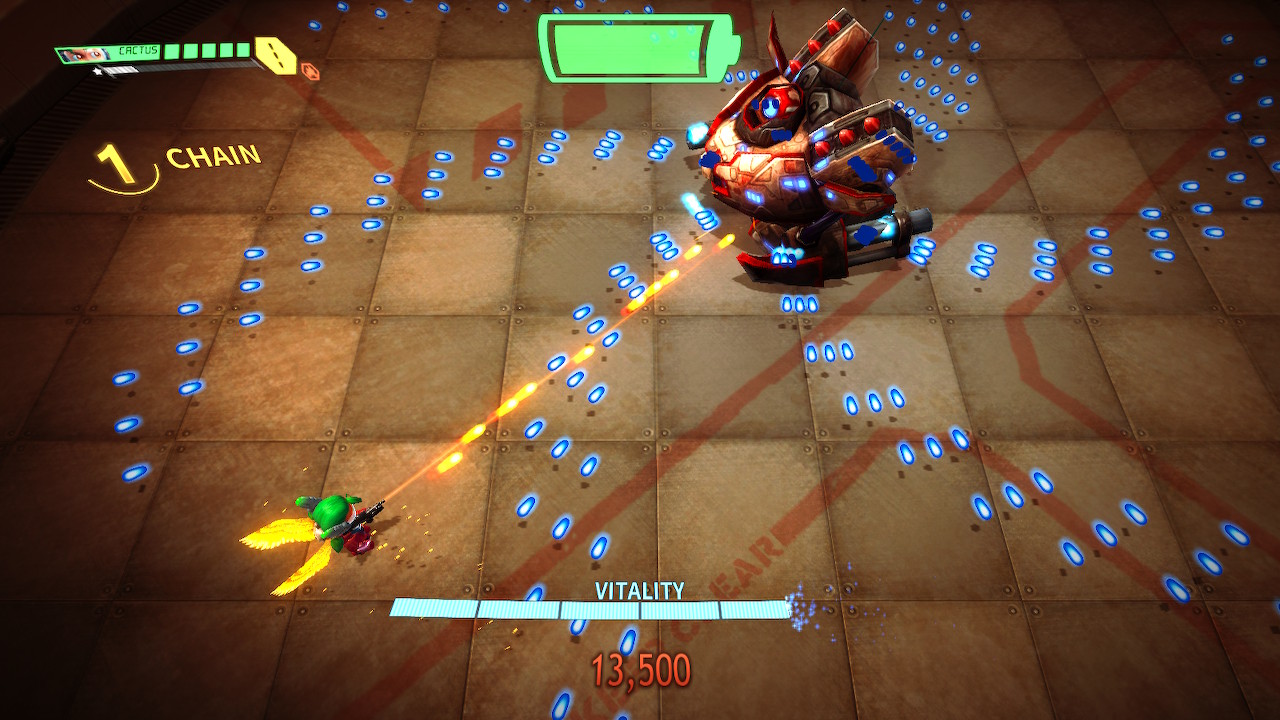
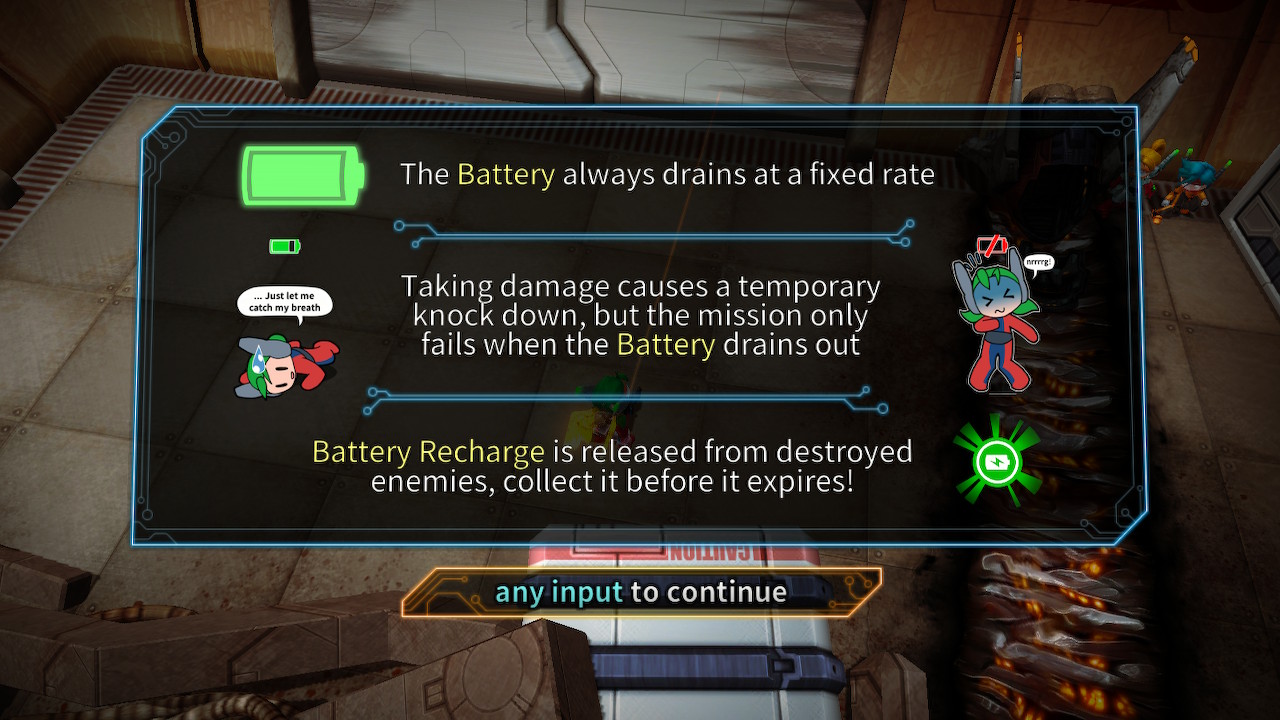
Beyond this, the only significant factor you’ll need to consider is the giant battery symbol at the top-centre of the screen; this will continually deplete at a steady rate during levels, and you’ll fail and have to restart the level if it fully empties. Fortunately, running out of health, seen in your corner of the screen (depending which numbered player you are), only temporarily downs you, but it reduces your score and wastes time which could be used picking up battery refills after eliminating a wave of enemies.

For a game with a lot of shooting and very little respite, Assault Android Cactus+’ variety keeps throwing fresh challenges at you in the form of new enemies or quirks in the level design. Early on, you’ll be dodging plenty of melee-focused robots that you can comfortably pick off from a distance. However, Cactus+ soon throws in several ranged enemies of increasing difficulty, forcing you to be continually on the move. Immobility equals swift and merciless death.
Beyond the increasing variety of enemies littered throughout the campaign, there are big bad bosses to contend with at the end of each section of levels. Equipped with their own unique weapons of android destruction, these bosses are consistently thrilling encounters, enacting their own brand of bullet-hell mayhem. Especially during these fights, your focus will be torn between aiming and madly dancing between their constant barrage of glowing hellfire.
Assault Android Cactus+ reveals more wrinkles and diversity in its dynamic level design the further you progress, keeping you well and truly on your toes. One level’s lights powered down at intervals, obscuring your vision to a narrow cone of torchlight following your aim, adding heightened tension in trying to avoid sneak attacks. Another level’s floor layout changed after each wave of enemies, constantly shifting the battlefield and preventing you from settling behind a single piece of cover.

Thankfully, not all of Cactus+ is out to get you. After defeating enemies in a combo, you’ll be rewarded with an assortment of brief power-ups, ranging from increased speed, to more firepower, and an EMP blast that momentarily stuns enemies. During some of the most hectic battles, timing a good power-up conjures the brief moment of inner peace you feel when plugging your phone into the power seconds before going flat.
Perhaps intimidatingly so, Cactus+ is an almighty cacophony of competing colours, flashing lights and a thumping soundtrack all happening at once. In light of this, the team at Witch Beam added accessibility options, most notably auto-aim, to help players of all skill levels enjoy the game. When playing local co-op, the auto-aim succeeds in onboarding newer players daunted by the non-stop nature of the twin-stick genre.
Instead of having to wildly flail both sticks while getting surrounded by enemies, the game will automatically aim at the nearest enemy, only requiring you to move and shoot. There’s still plenty of challenge while using auto-aim too, especially later in the campaign, where weaving between attacks is stressful enough, let alone aiming and firing back.
In eliminating the stress of aiming while constantly moving, Cactus+ empowered my teammates by making them feel like they were contributing without being overwhelmed. You can even play with a singular Joy-Con, reducing the amount of standalone controllers required to play multiplayer with friends or tenuous acquaintances.
My only complaint regarding auto-aim was that it appeared to be a blanket setting, as opposed to an option each player could opt-in or out of. With this setting active, you can still use the right-stick if available on your controller, but it just felt a little weird having to readjust my aim if I relaxed the stick briefly. Otherwise, it’s a fantastic option to have and hopefully sets an example for other games to evaluate their own accessibility choices.
One small issue while playing Cactus+ was I felt that receiving damage lacked adequate feedback. There’s a faint audio cue and a tiny controller rumble to signify damage, but it’s easy to miss and I found myself running out of health without realising on several occasions. I realise in such a frenetic game it’s difficult to generate noticeable feedback without being distracting, but perhaps the rumble could be slightly cranked up to give more punchy feedback.
Most impressively, Cactus+ runs flawlessly on the Switch. The developers have publicly discussed how much work they put into aiming for 60 frames-per-second, and it shows. Not once during my time with Cactus+ did I encounter any slowdown, no matter how many enemies, bullets or visual effects flashed on the screen. In contrast to highly-acclaimed indie twin-stick shooter, Enter the Gungeon – which does slow down slightly during some particularly brutal boss fights – Cactus+’ technical performance is a stunning achievement.
As if everything else wasn’t enough, Assault Android Cactus+ is ridiculously crammed full with content. There’s a more difficult campaign+ after finishing the vanilla campaign, a boss rush mode, and a survival mode – just to scratch the surface. Also, buried in the game’s Collections menu are a bunch of EX Options to unlock, including a modifier that lets you play the entire campaign in an old-school Doom or Wolfenstein first-person style.
It’s wild how much stuff there is to do on top of competing for leaderboards – which I took full advantage by getting the top spot on at least one level during pre-release access, just to be that wanker.

A technological marvel and an absolute blast to play, Assault Android Cactus+ sees a great Aussie indie game excel on Nintendo Switch, taking a notoriously difficult genre and making it welcome for all, while still adding in even more challenge for returning fans.