

‘Ant-Man’ Proves Yet Again That Marvel Has A Problem With Death
Without real stakes, what's left?

Released in Australia last week, Ant-Man is infused with the sort of energetic delight that was found in early Marvel films — like Iron Man (2008), Captain America: The First Avenger (2011) and Thor (2011) –before they increasingly began to feel like elaborate homework bogged down in exposition for future sequels.
It’s a B-movie writ large big-budget extravaganza, which excels the most when Paul Rudd – simultaneously proving his range, while enhancing his most-loved everyman traits – shrinks and interacts with the world like Honey, I Shrunk the Kids (1989), but with added biceps and Thomas the Tank Engine gags.

But no matter how fresh Ant-Man feels in the ever-expanding Marvel Cinematic Universe, it has become increasingly hard to ignore a truth about these films: they treat death in a limp, half-hearted manner, and struggle to adequately represent the real consequences of violence.
In these films, death is almost always presented as a non-issue, an ugly aspect of the superhero trade – highlighted more centrally in Batman films, and the recent Man of Steel – that is shunted off to the sidelines, relegated to unimportant secondary characters and forgotten about in the blink of an eye (or the detonation of pyrotechnics). Cities are destructed and rebuilt easily, while characters die and are resurrected almost instantly — rendering the drama impotent, and its action without consequences. And Ant Man is no different.
Warning: Spoilers Ahead
This is hardly surprising given Ant-Man’s more child-friendly tone, but it’s still disappointing. Even the death of the main villain is left ambiguous, as he implodes into what appears to be a ball of light, or maybe another dimension. The only good guy to die is an insect sidekick, a character whose death initially appears to be of some significance, but who is quickly forgotten about and goes unmourned. Presumably the sight of a miniature adult man visibly grieving the loss of an ant was a preposterous bridge too far for Marvel head honcho Kevin Feige, whose allegedly image-conscious attitude has seen prestige directors Patty Jenkins, Ava DuVernay, and Edgar Wright leave Marvel projects due to “creative differences”.
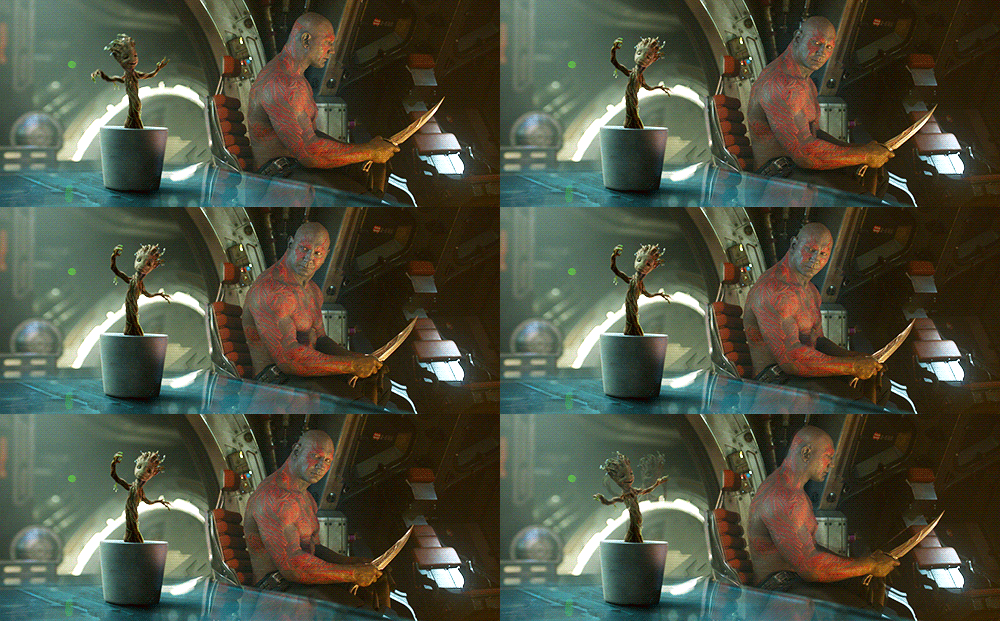
Audiences of Guardians of the Galaxy, meanwhile, were barely given ten minutes to mourn the adorably monosyllabic sentient tree Groot, who bravely sacrificed himself for mankind — before he was resurrected in the form of a cute and funny dancing sprout. By the end of opening night, his non-death was no longer a secret; within two weeks of opening weekend, director James Gunn was discussing it in interviews, and Marvel had officially released a clip of the scene that proved he wasn’t really dead. So much for spoiler warnings, eh?
Also originating from Marvel, Disney’s Big Hero 6 features the strongest representation of death so far, which should come as no surprise — Disney killed Mufasa after all. But while the deaths of the hero’s mother and brother (yeesh!) were affecting, the way the film handles the climactic and more emotionally heightened death of Baymax — the lovably sentient robot BFF of the hero — again underlines Marvel’s tendency to rely more on audience identification with family than on complex storytelling. Baymax sacrifices himself for the greater good, before being resurrected mere minutes later via micro-chip, cheapening the emotional response and reducing the impact of its drama. Why not wait until at least the sequel to bring him back, and let audiences grapple with the very real concept of losing a best friend in the meantime?
While nobody expected any of the Avengers to die in either of their first two ensemble features, it was widely accepted that the unceremonious death of Agent Coulson was one of great impact. It helped bring the Avengers together. Writer/director Joss Whedon is known for pulling stunts like this across Buffy the Vampire Slayer, Firefly and others, reflecting real life better than most: after all, death isn’t something that just occurs to sacrificial nobles; it happens unsuspectingly and heartbreakingly, in a flash. Nevertheless, while Whedon has said that Coulson is dead as far as the MCU is concerned, he was resurrected for S.H.I.E.L.D. — a move which rendered his death as retroactively manipulative, and no more effective than a slasher movie bringing its killer back from the grave time and time again.
In this universe, death ultimately doesn’t mean a thing.
Without Real Stakes, What’s Left?
Can audiences not be trusted to cope with the death of a character, perceived or otherwise? In a piece pre-dating Age of Ultron and Ant-Man, Jacob Hall at Screen Crush shone a rather alarming light on the numbers, citing the bouncebacks of Coulson, Fury, Locki and Bucky to showcase Marvel’s “unwillingness to make the death of likable characters permanent”. The closest the universe has come to rectifying this habit has been with the death of Thor’s mother in Thor: The Dark World — but given she had only eight lines of dialogue in Thor and 19 in its sequel, her loss was hardly the equivalent of, say, Gwen Stacy (The Amazing Spider-Man 2). In fact, the only good thing about that movie was its willingness to off a major character and love interest; I can only hope Thor: Ragnarok (2017) offers some narrative repercussions.
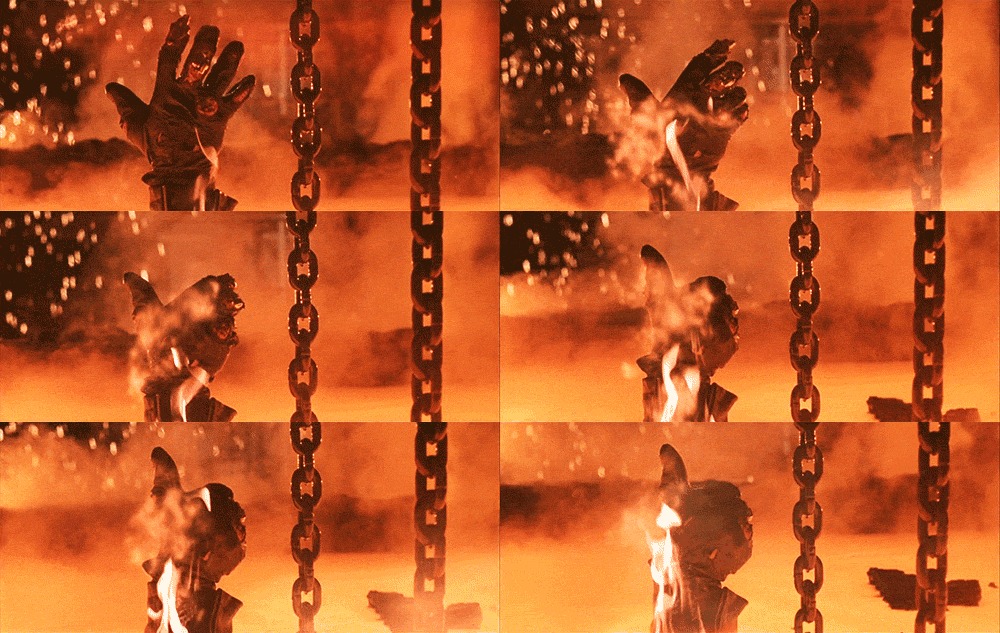
While it is becoming one of Marvel’s trademarks, the undercutting of death is a phenomenon that applies to franchises more broadly. Despite Terminator 2: Judgement Day (1991) ending with the profound and emotional sequence of Arnold Schwarzenegger’s T-800 terminating itself to ensure the survival of the human race, subsequent Terminator films have long since made the potential for the loss of any of its characters a moot point. Who can be invested in the fate of these characters when filmmakers can just change history again to bring them back?
Likewise in Avatar (2009), the death of Sigourney Weaver’s Dr. Augustine was a pivotal moment in the development of its lead character’s emotional journey — but she will return in James Cameron’s sequels. This reeks of lazy filmmaking, and a disinclination to create new, exciting, interesting characters that audiences can relate to. One of cinema’s greatest abilities has always been the cathartic reaction films can elicit from the most strange and surprising of places. It’s something at which big-budget TV like Game of Thrones has succeeded at, continuing to surprise and shock while stopping audiences from getting complacent, and raising the dramatic stakes in the process.
The idea that literally anybody can come back if you fudge the details enough cheats audiences of that feeling.
Ant-Man Will Return
Ant-Man ends with the protagonist stating he will return — just like every other MCU film. That was already a given; Rudd was surely contracted to several follow-ups before filming was even underway. Neither he nor other good guys like Michael Douglas and Evangeline Lilly ever truly feel in danger of their character’s deaths, but if Marvel don’t want audiences to get jaded before the two-part Avengers: Infinity War (2018 and 2019), then it’s time to shake things up in ‘phase three’.
The success of Inside Out (2015) shows that audiences can handle complex emotions in fantastical situations. Hollywood blockbusters shouldn’t be afraid of them. By short-changing audiences of the very real consequences of violence, they’re stopping their films from achieving the very humanity that their characters are attempting to protect.
–
Ant-Man is in cinemas now.
–
Glenn Dunks is a Melbourne-based freelance writer, editor and film festival programmer. He tweets from @glenndunks