

Some Tips For International Women’s Day, From The A+ Ladies At All About Women
"Intersectionality isn't just a conversation for uni students; it's a way to live."

As we wade deeper into the murky waters of 2017, it’s clear we’re living in a scarier reality than we were hoping for this time last year. The US now has an openly misogynistic tangerine president who plans to actively diminish women’s rights. At home we have a government that struggles to appeal to anyone at all, and the rise of a party that thinks Putin is the gold standard of leadership. We have entered the darkest timeline.
But among that darkness, there’s hope. There are spaces to come together and inspire each other to fight back. All About Women, an annual celebration and discussion of women and feminism at the Sydney Opera House can be one of those spaces. And on International Women’s Day, it’s important to celebrate and re-evaluate where we’re at.


This year’s festival featured engineer, author and activist Yassmin Abdel-Magied, writers Lindy West and Clementine Ford, microbiologist Guila Enders, astronaut Carmel Johnston, Worimi lawyer Josephine Cashman, Pulitzer Prize-winner Mei Fong, and comedian Jess Thom joking about her Tourette’s. It did, however, feel like some groups were underrepresented in the overall program and major panels. It would have been good to hear more from First Nations women, trans* women, women with disabilities, or people of the LGBTQI community. A major platform was instead given to a non-convicted rapist to wax lyrical about the concept of responsibility – which arguably has more to do with stirring up controversy than it actually has value for the people hearing about it.
Admittedly it’s impossible to represent every single type of woman and their individual experience, but it’s worth keeping in mind for both the event next year and also your own celebration of IWD today! Being able to meet and discuss feminism and the challenges that face different types of women today is a beautiful and valuable thing, and so much is gained by having that community and solidarity with each other.
Here are some of the lessons to come from the talks themselves:
1. Be Seen And Heard

It’s not surprising that this was a main theme at an event titled All About Women, but it’s still important advice. Advocating political participation, Van Badham said: “if you are not active in democracy, you get Donald Trump”. In her talk ‘Shrill’ (titled after her book of the same name) Lindy West had this advice: “you need to celebrate the fact that you are a loud woman refusing to be quiet”.
Something that rang true of all the talks at AAW this year is that there is no room for complacency. We need to show up and speak out now more than ever. Yassmin Abdel-Magied calls on us to “recognise our own agency”, despite living in a time where being persistent constantly feels like we’re pushing uphill.
The ‘Nasty Women’ panel – a discussion that included some of the most outspoken feminists of the hour – reiterated that solidarity is not a dirty word. In fact, it’s the only thing keeping us together and moving forward. In a time when people selling hate want to divide us, we can’t be complacent about the things that matter. We need to attend protests, write to our local members and call injustice out when we see it.
2. Persist

In her opening speech ‘Women In Media’, Geena Davis (Academy Award-winner, Olympic archer and founder of the Geena Davis Institute for Gender Diversity) addressed the “symbolic annihilation” of women in television and film. She spoke about her own feeling of “wanting to take up less space in the world”.
It’s a feeling that most women recognise, whether it’s wanting to make yourself physically smaller, quieter, more invisible. Davis spoke of the power that comes from pushing through that barrier, and the opportunities on the other side.
In one of the most powerful and rousing moments of the day, Van Badham took the opportunity to remind us that, “We can find strength in the women we know, the women who fought before us, and the women who will come after.” We are part of a long tradition of women and girls fighting for equal rights, and our desire to create a better future is an incredibly empowering thing, and one that we can’t forget.
An overwhelming number of the speakers on Sunday emphasised the need for women to feel the rage. To let anger energise and motivate us. To persist despite the ugliness of the world that is slung at us. Which brings us to point three…
3. Show The Turdbuckets The Door

Feminism is not a consequence-free hobby. While constructive criticism is good and can make you both a better feminist and a better human being, toxic bilge is unlikely to do either of those things.
But never fear: sour and bitchy misandrists of the world unite! Clementine Ford had some excellent advice for troll-slaying in her “girl power group therapy session” aka ‘Hate Male’. Putting hate mail up on public display, laughing at and ridiculing it made it more digestible. As Ford says, “sunshine and laughter is the best disinfectant”, and sometimes it’s good to take a break from raging and just laugh.
She also had some excellent tips for dealing with online hate that comes from men whose limited power has been threatened. Ford’s advice comes straight from Harry Potter:
“Trolls are boggarts of the internet.”
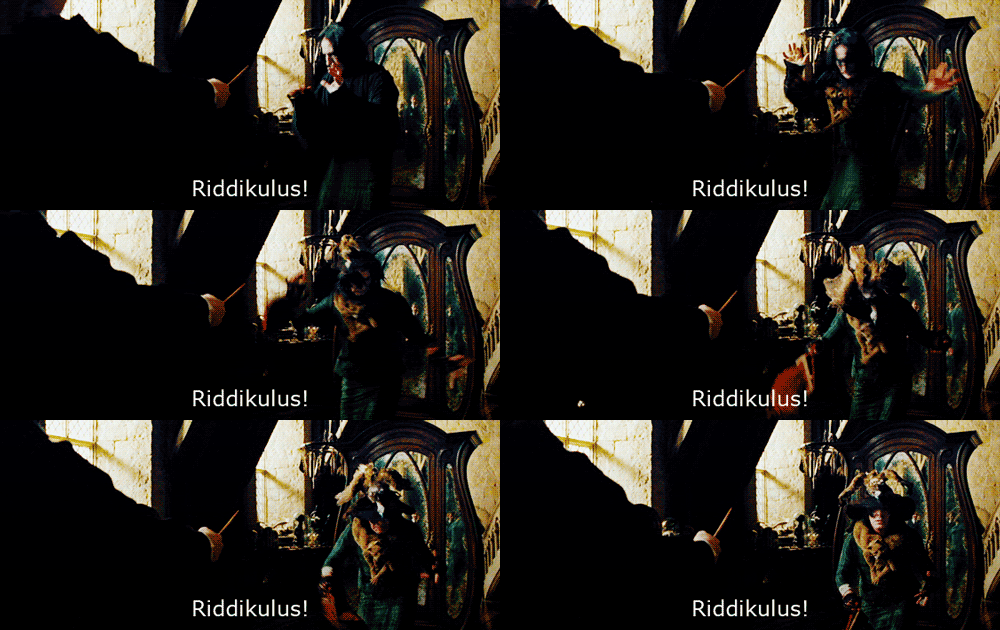
These men who threaten us take on the shape of the things we fear most, just like a boggart. They spew violent, sexist, hateful words. The sheer amount of vile correspondence people like Ford receives is mind-boggling. But Ford says that treating them as real and legitimate only hurts us. Painting them as an object of ridicule — a barf bag, a dick blister, a turd bucket — laughing at them destroys their power.
4. Intersectionality Isn’t Just A Conversation For Uni Students; It’s A Way To Live

As Lindy West put it: “feminism without intersectionality is just white supremacy”. The world does not need some white lady to come in and reinvent activism, because it already exists.
So many of the discussions at AAW centred around the importance of intersectionality, and actively including those who haven’t been included in previous discussions.
As Yassmin Abdel-Magied wrote in The Guardian last year, “I can’t speak for the LGBTQI community, those who are neuro-different or people with disabilities, but that’s also the point. I don’t speak for them, and should allow for their voices and experiences to be heard and legitimised.”
Intersectionality isn’t about dictating to others what they need, it’s about running backup and listening. It’s about acknowledging where you experience privilege, looking to where it intersects with other people’s marginalisation, then leveraging your privilege in any way you can.
–
All images: All About Women/Prudence Upton.
–