

I Rewatched Every James Bond Film Ever And Ranked Them. Fight About It.
Yes, this list includes SPECTRE, too.
10. SPECTRE (2015)
Bond fights for relevancy in a world that doesn’t need 007 anymore (sure they’ve done this a few times, but it has bite in 2015). Mendes is back as director after Skyfall, and makes the case for why nobody does it better than Bond.
The film ditches the origin status of the Craig era, and jives more with the spirit of the franchise. The action set-pieces are an absolute blast, and Hoyte Van Hoytema’s cinematography adds a little old-school Hollywood class. Yes, it has problems, mainly in the modern plotting department where everything has to be connected (Purvis and Wade have their fingerprints on this one, grrrr). Christoph Waltz’s villain is underdone and it causes a serious imbalance of tension, and Léa Seydoux gets a few good moments but is sadly relegated to a damsel in distress.
Minor gripes aside, it’s still a cracking Bond film — heck, even Sam Smith’s whiny theme pops with a tantalising Cthulhu-inspired credit sequence.
–
9. Goldeneye (1995)
The Bond franchise went on a six-year hiatus following License to Kill, and proved that absence makes the heart grow fonder. Goldeneye played to the strengths of the series and proved that despite countless imitators, parodies and beefed up American competition, there was still a place for Bond in the modern landscape of film.
It’s Brosnan’s finest moment in the role and Judi Dench is a superb addition to the franchise as the first female M. Goldeneye also features Sean Bean as the rogue agent 006 (it’s so great when other 00-agents show up in the series), and the actor lives up to his reputation with one of the most explosive Bean death scenes ever.
–
8. On Her Majesty’s Secret Service (1969)
The one with the Australian, George Lazenby, who walked away from playing Bond after only one film — but what a way to go out. Bond faces off with his arch-nemesis Ernst Stavro Blofeld (Telly Savalas) in the Swiss Alps, and falls for Contessa Teresa di Vicenzo (Diana Rigg, one of the all-time great Bond girls). The Alps-based action is excellent, but it’s the finale that forever leaves an impression on the series.
Bond marries Teresa, but Blofeld kills her during a drive-by shooting after the nuptials. The final shot on the bullet hole in the window as Bond cradles his wife is incredible, and one of the few times the series takes a risk to establish vengeful continuity. Due to the Lazenby fiasco and Blofeld/SPECTRE legal woes, the series never fully delivers on the implications of On Her Majesty’s Secret Service, despite referencing Teresa’s death in several future films as well as casting a light shadow over Bond’s allergy to commitment.

Happily never after.
–
7. You Only Live Twice (1967)
Despite Bond going to Japan and getting a little racist (he disguises himself as Japanese man in the most 1967 way), there is so much Bond iconography in You Only Live Twice, most famously parodied in the Austin Powers series and The Simpsons episode You Only Move Twice (the highest compliment for the film).
It’s where we get to see the scarred face of Blofeld (Donald Pleasence) after only seeing him in the shadows patting a cat in From Russia with Love and Thunderball; there are also ninjas and a volcano lair. Repeat: a volcano lair.
The final assault on the volcano lair as ninjas face-off against Blofeld’s henchmen is pure Bond bliss.

Nothing says ‘success’ like a volcano lair.
–
6. The Spy Who Loved Me (1977)
Third time was a charm for Moore, who bounced back with the help of Barbara Bach (she’s the spy who loves him) and the uber-henchman with the metal teeth, Jaws (Richard Kiel). Submarine cars, underwater bases (not as good as a volcano lair, but close), and a scenery chewing megalomaniac villain played by Curt Jurgens.
The Spy Who Loved Me also takes the prize for having the best Bond theme by far: Carly Simon’s Nobody Does it Better may be one of the sexiest songs ever written, and was covered beautifully by none other than Radiohead.
–
5. For Your Eyes Only (1981)
The film where Moore earns his cred as Bond, and a good way to shut down any naysayers of his tenure in the role. The subplot involving a sexed-up figure skater is bonkers, yes, but Bond’s hand in the revenge plot of Carole Bouquet’s Melina Havelock drives the film — and a scene where Bond stone cold kicks a car teetering off the edge of a cliff, allowing an assassin to perish in a fireball, is a reminder that Bond is licensed to kill, and Moore has that killer instinct.

–
4. From Russia With Love (1963)
Bond goes head-to-head with the assassin Donald ‘Red’ Grant, played by the legendary Robert Shaw. It’s a moment in the series where duality factors into assessing the difference between an assassin working for an evil organisation (Red) and a 00-agent working for the British government (Bond) — different sides of the same coin.
The Bond franchise rarely pauses to consider what separates Bond from the evildoers when he takes a life, but From Russia with Love comes pretty close.
–
3. Live and Let Die (1973)
The Blaxploitation Bond that introduced us to Moore, and it’s his best outing as 007. Look, a lot of the film hinges on the racial tension that comes from Fleming’s book of the same name — that is completely backwards by modern standards, as are a lot of his books — so you have to take it all with a grain of salt. But for all the flaws in the foundation of Live and Let Die, it’s an absolute riot that fuses together the wildest elements of the Bond franchise while embracing a little voodoo.
Yaphet Kotto is one of the definitive Bond villains as Dr. Kananga and his henchmen: Tee Hee (with an awesome mechanical pincer for an arm), Baron Samedi (Geoffrey Holder commands attention in every scene) and Whispers (who only speaks in whispers) are the perfect unconventional antagonists for Bond. The magnetic buzz-saw watch makes an appearance; there’s a crazy young Jayne Seymour; Bond escapes alligators ready to feast by hopping across their backs (performed by a stunt guy with real alligators); and Paul McCartney’s theme tears it up to give the film a frenetic energy.
–
2. Casino Royale (2006)
Bond begins. One of the great resurrections of the new millennium that started the origin trilogy featuring Craig. It’s apt they decided to reboot Bond by adapting the very first Fleming novel of the same name, featuring Bond in a high-stakes poker game against the terrorist banker, Le Chiffre (Mad Mikkelsen). Casino Royale gets to the core of Bond as an elite killer while still indulging the little bits of escapism and modern action (the parkour sequence is incredible), and throwing in nods to the series.
Like Bond post-Die Hard, the series had another game-changing contender in the Bourne films, which hung as a rival franchise that had done spy-craft exceptionally well, and altered the audiences’ expectations of espionage thrillers. Bond proved to endure mainly because Craig played Bond grounded and very much a rookie — he only just earns his 00-status at the beginning of the film. After being in company of Bond for so long that he’s almost immortal, it’s refreshing to see the character be vulnerable and make mistakes.
Bond was relaunched perfectly after the soured Brosnan era, and it was a fresh start that enabled EON Productions to learn from the mistakes of the past and try to tinker with elements of the series with restraint. The relationship between Bond and Vesper Lynd (the ethereal Eva Green) was crucial to one of the big learning curves that re-establishes the Bond character, and you got a real sense of how he would become the agent you’d known for decades. Everything in Casino Royale feels fresh but with a hint of the familiarity that makes it top-tier Bond.

–
1. Goldfinger (1964)
It doesn’t matter what your favourite is: when you think of 007, Goldfinger springs to mind. It’s ingrained into the DNA of the franchise and it refined all the elements needed to make an amazing Bond film. EON Productions found their groove only three films in and built an empire out of it, using the template of Goldfinger for everything that followed.
Even if a film is resisting the sillier elements of the franchise — and there are plenty in Goldfinger — there is still time to reference it (only recently, Skyfall was full of them). Goldfinger introduced the pre-credit sequence with a tangential link to the main plot; it has the first of many Q branch briefings with all the gadgets; and it’s where the Aston Martin DB5 became the car synonymous with Bond. Oddjob launched the concept of henchmen with deadly assassination gimmicks, and Pussy Galore (Honor Blackman) allowed the series to get away with murder when it came to tongue-in-cheek innuendo. It’s also the first time Shirley Bassey belted out a Bond theme that became a huge hit on music charts around the world, and set a standard for the themes that followed.
The brilliance of Goldfinger is how it fully embodies the escapist fantasy of 007: it’s the cinematic vision of Bond at its purest. For over 50 years, the Bond franchise has evolved and occasionally been at odds with itself in its search for relevance in changing times. Goldfinger is the perfect time capsule of confident, fantastical indulgence, male bravado, glamour, sleaze, and sophistication — all side-by-side in one marvelous film.
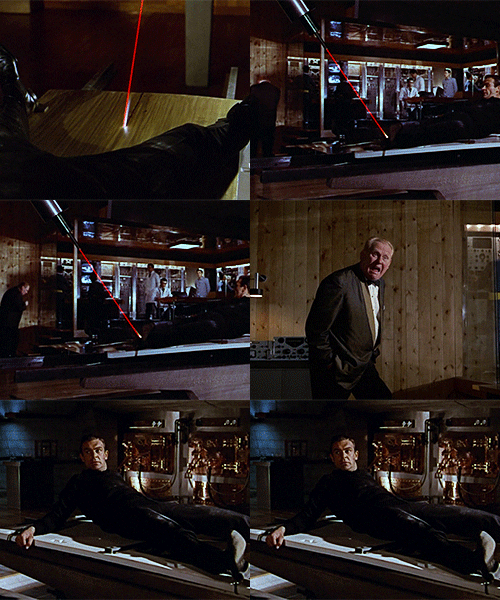
Genuine dick threats. James Bond’s worst fear.
–
SPECTRE is released in Australia on November 12.
–
Cameron Williams is a writer and film critic based in Melbourne who occasionally blabs about movies on ABC radio. He tweets from @MrCamW